APFL LEAGUE RULES
Roster
Injuries
Playbook
Violations
Scheduling & Awards
Offseason
Breaking Ties
Download
75 SP TOUCHES
Jump to a specific Section:
Section I: Roster | Section I.10: Injuries | Section II: Playbook | Section III: Violations | Section IV: Scheduling and Awards | Section V: Offseason | Section VI: Breaking Ties
Section I: Roster Rules
a. On opening day of the season, a team can have a maximum of 50 players.
b. All player ability totals must be used in the team file and must accurate.
c. Offensive players may only play on offense.
d. Defensive players may only play on defense.
a. Hidden Slots are illegal (mainly applies to Mac users). You can only use the default team file options.
b. Players may not appear more than once in a team file.
a. Improvements are any adjustment (in increments of 20 points) which increases or decreases an ability.
b. Abilities are strength, agility, intelligence, discipline, and speed up to 50 (speed can only be increased above a 50 based on draft prospect/walk-on player rules). You can adjust strength from an 80 to a 90 if you choose.
c. A pre-season list of 10 players will be submitted by each coach prior to the start of the season. Each player will have a requested ability increase and three (3) players will be randomly selected from this list for improvement. Rookies are not eligible for this list.
d. After week 5 of the regular season, each coach will select one player from his team and one ability to be improved. All players are eligible for this improvement, including rookies.
e. Following their first season, all rookies will improve in one random ability. This improvement may be declined or accepted as an increase or decrease.
f. A post-season list of 10 players will be submitted by each coach prior to the start of the season. Each player will have a requested ability increase and three (3) players will be randomly selected from this list for improvement. Rookies are eligible for this list.
g. No ability may ever be increased to a 100, with the exception of the participation upgrade award and the rookie draft rules.
a. When a player completes his 5th season, he is eligible for retirement based on the following schedule:
Completion of 5th Season: 25%
Completion of 6th Season: 50%
Completion of 7th Season: 75%
Completion of 8th Season: 100%
c. Players who will retire at the end of the season are announced after week 3 of the regular season.
d. Players who are retiring may be released into the free agency pool.
e. All players in the free agency pool who are in year 8 will announce their retirement at this time.
f. If a player does not retire, there is a random chance that the player will receive a decrease in one ability due to age, but not until the end of his 6th season. The abilities that can receive a decrease are Speed, Strength, and Agility. The percentages used are identical to the percentage chance of retirement (see 1.5.a).
g. Any player signed from the free agency pool in year 5 or later, who is signed after retirments have been announced, will automatically retire at the end of the season.
a. Trading begins immediately following the completion of the NYPFL title game. Trades may then occur until the trade deadline (Monday 11:59pm “coaches-time” following the games of Week 7).
b. As a general rule, no coach may oppose a trade. However, if a coach feels that the trade hurts the “integrity of the league” that coach must email the league office. If the league office feels that the trade could effect the integrity of the league, the league office will either disallow the trade or call it to a rules committee vote.
c. Draft picks may be traded for the upcoming/current draft, or for the draft for the following season (during the offseason only).
a. In the off-season there will be a 7-round rookie draft.
b. The draft order will be determined by reversing the order of finish from the previous season. The team with the worst record selects first in each round. Tiebreakers to determine the draft order will be exactly as the NFL.
c. The draft order will be adjusted based on any penalties which have been incurred by an owner.
d. Drafts will be held in person, via Skype, or via Facebook messenger or shortly after the APFL title game. If you can not attend the draft it is your responsibility to make arrangements to get your selections in.
e. If you do not submit a list or make other arrangements, you will be skipped. There is no auto-draft feature, this is not fantasy football.
f. The rookie draft list will be announced after week 8 of the regular season.
a. Each teams’ top receiver and rusher will not be subjected to the random injury system, but will instead be part of an overuse system.
b. All other players are subject to both the overuse system and the random injury system.
c. The injury system uses a multiple on a per touch basis, also known as Position Risk Factor. All OL have a 5% risk of being injured, regardless of whether they also receive touches. If a player is determined to be injured, they are injured for just 1 week. Below is the Position Risk Factor breakdown:
QB.003
RB.004
WR.008
OL.003
DL.014
LB.007
DB.007
KK.007
a. Each team will receive a list of 5 possible 50* SPD walk-on players during the offseason.
b. That player can become a 75 SPD player at the end of their rookie season if they meet specific touch thresholds. The thresholds for walk-on players will be as follows
RBs (HB/FB)
3rd offense: 1 week injury with a 50% chance it turns into a 2 week injury
3rd offense: 2 week injury with a 50% chance it turns into a 3 week injury
WR/TE
1st Offense
14-16 reception: 25% chance of a 1 week injury
17-19 touches: 1 week injury
20+ receptions: 2 week injury
14-16 receptions: 1 week injury
17-19 receptions: 2 week injury
20+ receptions: 3 week injury
14-16 receptions: 2 week injury
17-19 receptions: 3 week injury
20+ receptions: out for season
14-16 receptions: 3 week injury
17+ receptions: out for season
14+ receptions: out for season
1.11 – Week #10 + Postseason Injury System
a. If you announce that you are sitting your starters, and you sit every single starter you can/put them in the lowest team file spots, your team is immune to all random injuries for week #10. ***Please ask if you have any questions. If you do this wrong, you will not receive the benefit***
Section 1.10: Overuse Injury System
RBs (HB/FB)
3rd offense: 1 week injury with a 50% chance it turns into a 2 week injury
3rd offense: 2 week injury with a 50% chance it turns into a 3 week injury
WR/TE
1st Offense
14-16 reception: 25% chance of a 1 week injury
17-19 touches: 1 week injury
20+ receptions: 2 week injury
14-16 receptions: 1 week injury
17-19 receptions: 2 week injury
20+ receptions: 3 week injury
14-16 receptions: 2 week injury
17-19 receptions: 3 week injury
20+ receptions: out for season
14-16 receptions: 3 week injury
17+ receptions: out for season
14+ receptions: out for season
1.11 – Week #10 + Postseason Injury System
a. If you announce that you are sitting your starters, and you sit every single starter you can/put them in the lowest team file spots, your team is immune to all random injuries for week #10. ***Please ask if you have any questions. If you do this wrong, you will not receive the benefit***
Section II: Playbook Rules
2.1 – Playbooks
a. Every regular season playbook must have a minimum of 20 offensive plays with a minimum priority of one (1) in an AI box.
b. There is a limit of one (1) screen pass per playbook. A screen pass is any pass diagrammed to be caught behind the LOS, where there are at least 2 offensive players in front of the receiver within 7 yards. If it’s borderline, it will be considered a screen pass. No exceptions!!!!!
c. Any mirrored play counts as a second play. Offensive Linemen must be swapped so that the RT does not play the LT and the RG does not play the LG and so on.
d. There are no limitations on a defensive playbook.
e. Each owner is responsible for protecting their playbook with a password.
f. Use of plays from other coaches (either from the APFL or other leagues) must be consensual and credited.
g. DO NOT PLAGIARIZE!!!
h. Playbooks must attempt to gain yards and score points. Any obvious attempts to lose games will result in +1 win getting added to your record in terms of draft position. You will also auto lose all tiebreakers.
2.2 – Offense – Line of Scrimmage
</p
a. On a running play, no offensive player may be assigned any kick, fake or pause command beyond the LOS. The point of assignment for these commands MUST be diagrammed at least 1 pixel behind the LOS on the offensive side of the football.
b. On a passing play, no offensive player may be assigned any kick, fake, pause, or blocking commands beyond the LOS. The point of assignment for these commands MUST be diagrammed at least 1 pixel behind the LOS on the offensive side of the football. There is no such restriction with blocks on passing plays caught behind the LOS, where running rules apply.
2.3 – Offensive Formations
a. All offensive formations will be considered legal as long as all of the rules to offensive players are followed (See 2.4).
a. QB – The QB must always be lined up directly behind the center, in the shotgun or under center. The front-most pixel of the QB must be 7 yards or less from the LOS. The QB may never kick the ball. The QB may run with the football, regardless of distance from the LOS. The QB must take the snap from the OC.
b. K – The kicker is the only player allowed to punt, kickoff, kick field goals and extra points and may not throw a pass or run with the ball.
c. HB and FB – You may line up your running backs anywhere you choose: in the backfield, on the line of scrimmage, or out wide. A player is considered “in the backfield” if his outside shoulder is just inside of the outside shoulder to the tackle. If any RB is lined up in any location other than in the backfield, only other RBs may occupy the backfield. On all running plays, your ball carrier MUST be lined up at least 4 yards from the LOS. He MUST be in the 3-pt stance OR be “in the backfield”, according to the above definition.
d. TE and WR – You may line up your receivers anywhere you choose. TEs and WRs may occupy the backfield so long as all of the RBs on the field are also in the backfield. WRs and TEs may not run with the football if they are lined up in the backfield. They may run with the football from any other location provided travel through the entire backfield (WR or TE end-around, for example).
e. OL – All offensive linemen and must be in the LT-LG-C-RG-RT formation and may not line up more than one body width apart.
a. The team file may contain only one QB and one K and they must occupy the designed slots in the team file.
a. All defensive formations will be considered legal as long as all of the rules to defensive players are followed (See 2.7)
a. DL – DL can only line up on the defensive line. There must always be a minimum of 3 DL on the field at one time. At least one DL must be assigned a rushing (pass or run) command on each defensive play.
b. LB and DB – LBs and DBs may line up on the LOS if they are outside of the DLs and the OGs – otherwise they must be at least one player length off the LOS. If they are in press man coverage, they may line up inside the DLs and the OGs due to their assignment – this is fine.
c. Catch, fake, block, and pass commands on defense are illegal.
d. Phasing (blitzing a LB/DB line up right behind a DL that is engaged with an OL) is illegal. The game does not take physics into account and results in a free, untouched blitzer.
b. Fake kicks are illegal.
c. Fourth down conversion attempts are legal if the QB is on the field.
d. Two point conversion attempts are illegal.
e. Onside kicks are illegal unless losing and may only be attempted in the ifnal 2 minutes of the gamew if the onside kicking team is losing.
f. On punt returns, a minimum of 3 players on the defensive side of the football must be lined up on the LOS. Two additional players must line up within 20 yards of the LOS.
Section II: Playbook Rules (Play Design)
#1: Offensive players running through each other
#2: Offensive Backfield Alignment
#3: Overhand/Underhand Pitches
All running plays must be given to the HB/FB underhanded and all pass plays must be thrown by the QB overhanded. This is a pretty common mistake for new coaches, but I have seen some veteran coaches also violate this rule. Usually, it’s a simple fix in the chalkboard editor, but realize these plays are illegal.
#4: Screen Passes
Screens are overpowered. There is little argument about that. The rule is 1 screen per playbook period. You cannot have a screen for a 2-minute drill and a screen for third downs etc. Additionally, all plays that are borderline screens will be considered screens. If I have to slow the game down or pause it to see where the player catches the ball, it’s a screen. And if it’s a scan pass, the design needs to be clearly beyond the LOS. If your game is re-run due to the screen rule violation, ALL screens in your playbook are deleted and then the game is re-run.
#5: At least 1 Defensive Linemen has to be given a rush command on each play
#6: Running Out-Of-Bounds
Players cannot be designed to run out of bounds. That goes for run plays, pass plays, kickoffs, punts, etc. Over the course of the play, especially scan passes that take a long time to develop, if a player’s route takes him out of bounds, that’s fine. But lining a guy up outside and running him directly out of bounds on the snap is illegal. Please check your plays to make sure your plays are good when it comes to this. Running out of the back of the endzone also counts towards this. However, I won’t penalize anyone if they have an AI issue. For example, they run fly patterns at the 10-yard line and the receivers run out of the back of the endzone.
#7: Mirrored Plays and Offensive Linemen
Your RT and RG and LT and LG must remain in those positions for the entire game. When you mirror a play it also moves your OL. You must correct them. Every play that is mirrored and not corrected is 100% illegal. This is something that almost everyone has 1 or 2 plays that get missed. I will not penalize a coach that has 1 or 2 of these plays, I will give them a chance to fix this first. However, every play that the RT is moved to LT is an illegal play. Multiple issues will no doubt get your game re-run. All mirrored plays will be deleted and the game re-run. This is a simple fix and I won’t have as much patience for these issues as I will have for simple design mistakes. If you keep forgetting, I wouldn’t use mirrored plays.
Every player on every play MUST have instructions. In other words, they MUST DO SOMETHING. From quick slants to long bombs every player has to be given commands to do something and just pausing doesn’t count. That counts for both offense and defense.
#9: Onside Kicks
Now that the rule for next season is officially inside of 2 minutes, I shouldn’t see any mistakes at all. I can show you how to exactly set your AI up so that it never happens. If you have two kickoff plays. One for all situations outside of 2 minutes and one set up for when you are tied or winning inside of two minutes, then you will never make a mistake as long as your onsides kick is only set for 2 minutes or less and when trailing. If you illegally onsides kick and recover it and win the game, then your onsides kick plays will be deleted and the game will be re-run. There will be no exceptions. If you recover an illegal onsides kick and throw a pick-six on the very next play but still win, the game is getting re-run. Please do not put me in this situation. I can clearly show you the AI on how to make sure it never happens. There is also a flaw in the AI of the generic kickoff where there is a possibility you will onsides kick inside of two minutes in the first half. Please be aware of that and correct it.
Phasing (blitzing a LB/DB line up right behind a DL that is engaged with an OL) is ILLEGAL on regular defensive plays. The game does not take physics into account and results in a free, untouched blitzer. Phasing is LEGAL on all special teams plays like punts, punt returns/blocks, kickoffs, field goal attempts, extra point attempts, etc.
Section III: Violations
a. A team file and playbook must be uploaded each week of the season and must reflect adjustments for injuries. A “brand new” playbook is not required. You may request an old playbook be used, however even if honored the failure to upload will count against you.
b. Each team is afforded 1 missed upload with no penalty.
c. A win will be credited for each missing book (added to the final win/loss record) and the draft order adjusted accordingly.
d. Three missed uploads will make all draft picks untradable for ALL seasons until there is participation in a full season without missing 3 or more uploads.
e. Four missed uploads and we will replace you if a viable coach is found. If no coach is found, and you stay in the league, you will draft dead last in each round of the rookie draft and be ineligible to trade draft picks.
f. If you have no missed playbooks, you will be awarded a participation upgrade after the rookie increases. This upgrade can be used to max out an ability on a player.
a. Only plays that ran during the game may be challenged for violation of the league rules.
b. All rules violations must be reported within 48 hours and are reported to the Rules Enforcement Committee.
c. The committee will make a judgment within 72 hours.
d. If it is determined that a coach has violated any rules, that coach must submit their playbook password to the commish.
e. ALL illegal plays will be deleted from the book by the commissioner or co-commissioner, regardless of whether or not they were run during the game.
f. If any violations are claimed on week 10 or in the playoffs which will impact the playoffs, games for the following weekend will be pushed back a week.
g. Rules Infractions Removal Process: If there are more than 2 screen plays found in a playbook, all screen plays are deleted from the book.
b. If a “necessary” play is illegal (kickoff, EP, etc) then the standard play that comes with all new playbooks is substituted in place of the illegal play. All other illegal plays are simply removed. The game is then replayed.
h. If a team file is illegal, any player which is in violation of the rules will have his abilities all set to zeros (0) and the game then replayed.
Section IV: Scheduling and Awards
a. Regular Season – The Regular season will be 10 games. Each team will play its division opponents twice, then play its remaining games against other teams. The commissioner will balance the schedule based on results from the previous season.
b. Playoffs – We will have 2 conferences each with 2 divisions. Each divison will have 4 teams. The 2 division winners and 3wildcard teams will make the playoffs from each conference.
c. American Bowl – The American Bowl will consist of the American and National Conference Champions. The team with the better record will be the home team. The American Bowl will be played 1-2 weeks after the conclusion of the Conference Championship games (both teams in the bowl can request 1 week or 2 weeks to prepare).
a. After the last regular season game is complete, each coach will receive a list of pro-bowl eligible players for each conference. Coaches will submit their votes before the start of the playoffs and may only vote for a maximum of 7 of his own players. Starters are determined based on who received the most votes, ties determined by the better statistical season.
b. Each coach will vote for an MVP for each conference. No coach is allowed to vote for one of his own players.
c. Each coach will vote for a Coach of the Year for the entire league. No coach may vote for himself to receive this honor.
d. Each coach will vote for rookies of the year and most improved coach of the year. No coach may vote for himself or any of his own players.
e. In seasons where we have hall of fame voting, each coach is required to vote.
Section V: Offseason
a. The offseason schedule will be released after the American Bowl and will announce the timeline for the offseason, including the draft and preseason schedule.
a. All coaches have an opportunity to recommend rule changes to the league.
b. The league office will determine if the recommendations are sound and should be reviewed by the rules committee.
c. The rules committee will discuss all potential rules changes and make voting recommendations, which are then returned to the league office.
d. Rule changes will be put to league vote at the league office’s discretion. The league office may determine that some rules need not go to a vote.
e. The commissioner and co-comissioner reserve the right to make any changes necessary to correct any league integrity issues or any other rules or issues that are deemed necessary at any time.
Section VI: Breaking Ties
6.1 – To Break A Tie Within A Division
a. Two Clubs
1-Head-to-head (best won-lost-tied percentage in games between the clubs).
2-Best won-lost-tied percentage in games played within the division.
3-Best won-lost-tied percentage in games played within the conference.
4-Strength of victory in all games.
5-Strength of schedule in all games
6-Best combined ranking among conference teams in points allowed in all games.
7-Best combined ranking among all teams in points allowed in all games.
8-Best fewest allowed touchdowns in all games.
9-Coin toss
b. Three or More Clubs
(Note: If two clubs remain tied after one-or-more clubs are eliminated during any step, tiebreaker restarts at Step 1 of two-club format. If three clubs remain tied after a fourth club is eliminated during any step, tiebreaker restarts at Step 1 of three-club format.)
1-Head-to-head (best won-lost-tied percentage in games among the clubs).
2-Best won-lost-tied percentage in games played within the division.
3-Best won-lost-tied percentage in games played within the conference.
4-Strength of victory in all games.
5-Strength of schedule in all games.
6-Best combined ranking among conference teams in points allowed in all games.
7-Best combined ranking among all teams in points allowed in all games.
8-Best fewest allowed touchdowns in all games.
9-Coin toss
6.2 – To Break A Tie For The Wild-Card Team
If it is necessary to break ties to determine the two Wild-Card clubs from each conference, the following steps will be taken.
1-If the tied clubs are from the same division, apply division tiebreaker.
2-If the tied clubs are from different divisions, apply the following steps.
a. Two Clubs
1-Head-to-head, if applicable.
2-Best won-lost-tied percentage in games played within the conference.
3-Strength of victory in all games.
4-Strength of schedule in all games.
5-Best combined ranking among conference teams in points allowed in all games.
6-Best combined ranking among all teams in points allowed in all games.
7-Best fewest allowed touchdowns in all games.
8-Coin toss.
b. Three or More Clubs
(Note: If two clubs remain tied after one-or-more clubs are eliminated during any step, tiebreaker restarts at Step 1 of two-club format. If three clubs remain tied after a fourth club is eliminated during any step, tiebreaker restarts at Step 2 of three-club format.)
Apply division tiebreaker to eliminate all but the highest ranked club in each division prior to proceeding to step 2. The original seeding within a division upon application of the division tiebreaker remains the same for all subsequent applications of the procedure that are necessary to identify the two Wild-Card participants.
1-Head-to-head sweep. (Applicable only if one club has defeated each of the others or if one club has lost to each of the others.)
2-Best won-lost-tied percentage in games played within the conference.
3-Strength of victory in all games.
4-Strength of schedule in all games.
5-Best combined ranking among conference teams in points allowed in all games.
6-Best combined ranking among all teams in points allowed in all games.
7-Best fewest allowed touchdowns in all games.
8-Coin toss
When the first Wild Card team has been identified, the procedure is repeated to name the second Wild Card (i.e., eliminate all but the highest-ranked club in each division prior to proceeding to Step 2). In situations in which three teams from the same division are involved in the procedure, the original seeding of the teams remains the same for subsequent applications of the tiebreaker if the top-ranked team in that division qualifies for a Wild Card berth.
6.3 – Tie-Breaking Procedure For Rookie Draft
a. Clubs not participating in the playoffs shall select in the first through 8th positions in reverse-standings order.
b. Clubs participating in the playoffs shall select according to the following procedures:
1-The losers of the Wild Card games shall select in the 9th through 10th positions based on won-loss-tied percentage in reverse-standings order.
2-The losers of the Divisional playoff games shall select in the 11th through 14th positions based on won-loss-tied percentage in reverse-standings order.
3-The losers of the Conference Championship Games shall select 15th and 16th based on won-loss-tied percentage in reverse-standings order.
4-The winner of the American Bowl game shall select last and the American Bowl loser will select next-to-last.
c. If ties exist in any grouping, such ties shall be broken by Strength of Schedule, easiest to hardest.
d.If ties still exist, apply the Divisional, Conference or Interconference tie-breaking methods, whichever is applicable.
1-For Divisional or Conference ties, use those procedures.
2-For Interconference ties, use the following procedures:
Ties involving TWO teams from different conferences will be broken by (a) head-to-head meeting; (b) strength of victory in all games, (c) best combined ranking among all teams in points allowed in all games, (d) best fewest allowed touchdowns in all games, and finally (e) coin toss.
75 SP Touch Increases
QB: A QB drafted in the 1ST round will gain the following rewards:
Any 2 abilities maxed out (SPD cannot be changed)
DIS set at any rating you want between 0-100
A 3rd round pick in next seasons rookie draft
QB: A QB drafted in the 2ND round will gain the following rewards:
Any 1 ability maxed out (SPD cannot be changed)
DIS set to any between 0-100
QB/OL/K upgrades happen immediately upon drafting them.
OL drafted in the 1ST round will gain the following rewards:
Any 3 abilities maxed out (including SPD)
A 3rd round pick in next seasons rookie draft
QB/OL/K upgrades happen immediately upon drafting them.
OL drafted in the 2ND round will gain the following rewards:
Any 2 abilities maxed out (including SPD)
QB/OL/K upgrades happen immediately upon drafting them.
K drafted in the 1ST round will gain the following rewards:
All abilities except speed maxed out.
A 3rd round pick in next seasons rookie draft
So he will be a X-100-100-100-100 kicker
QB/OL/K upgrades happen immediately upon drafting them.
K drafted in the 2ND round will gain the following rewards:
Any 1 ability maxed out except speed.
QB/OL/K upgrades happen immediately upon drafting them.
50* Speed HB/WR/TE/FB Touch Threshold Rules:
Round 1: 250
Round 2: 245
Round 3: 240
Round 4: 230
Round 5: 220
Round 6: 210
Round 7: 200
Round 1: 65
Round 2: 60
Round 3: 55
Round 4: 50
Round 5: 45
Round 6: 40
Round 7: 35
Round 1: 100
Round 2: 90
Round 3: 80
Round 4: 75
Round 5: 70
Round 6: 65
Round 7: 60
Round 1: 50
Round 2: 45
Round 3: 40
Round 4: 35
Round 5: 30
Round 6: 25
Round 7: 20
HB: 200 touches
FB: 85 touches
WR: 50 touches
TE: 40 touches
DE/DT/LB/CB/S: MUST start every regular season game in a team file slot that CANNOT be subbed out
Some Important Notes:
Starting in rookie draft season 8, the top 48 picks are set. So if you draft 6th in round 1, you will also draft 6th in rounds 2 and 3.
Starting with pick #49 (which is the first pick in round 4) we have the “reserved for reward” draft picks.
APFL Official Rulebook
Section 1 – Rosters
1.1 Team Files
- Team files must be properly populated with your player’s name and number, as well as position where applicable (SS v FS).
- All player ability ratings contained within the team file must accurately reflect each player’s official abilities.
- Team files must be updated weekly based on injuries or trades.
- Team files, unlike playbooks, cannot be password protected so that if necessary, we can check the attributes etc.
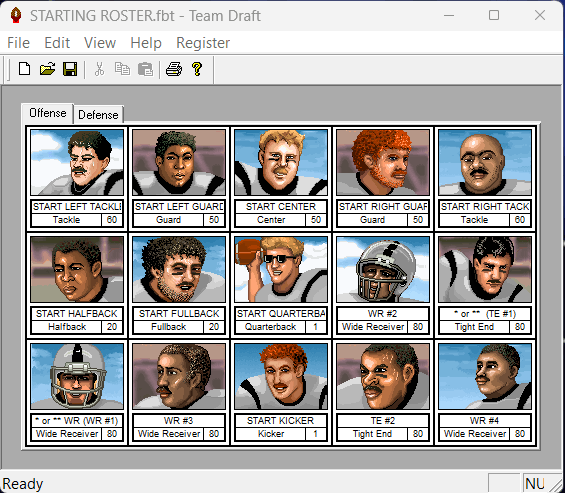
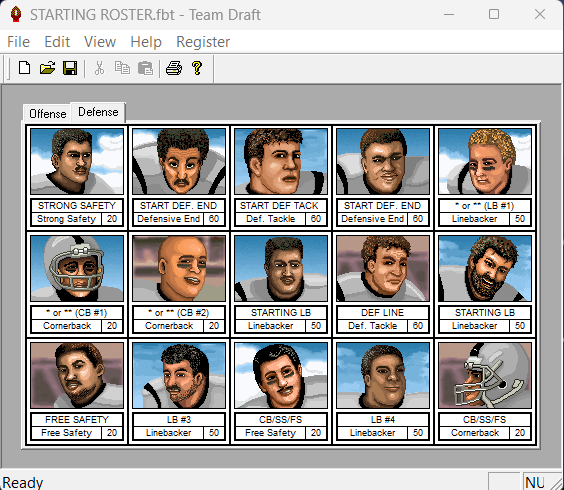
- Use the following team file examples for where the (single asterisk *), (double asterisk **), or any other “special player” needs to be.
OFFENSE (click for hi-rez)
DEFENSE (click for hi-rez)
Changing HB/FB positions (click for hi-rez)

1.2 – Rosters Limits
- On opening day of the season, each team may carry a maximum roster of fifty (50) players.
- Offensive players may participate only on offense.
- Defensive players may participate only on defense.
1.3 – Hidden Slots
- Hidden slots are prohibited.
- A player may not appear more than once within the same team file.
1.4 – Player Improvements and Abilities
- An improvement is any adjustment, in increments of twenty (20) points, that increases or decreases a player’s ability.
- Abilities are strength, agility, intelligence, discipline, and speed up to 50 (speed can only be increased above a 50 based on draft prospect/walk-on player rules). You can adjust strength from an 80 to a 90 if you choose.
- Before the season begins, each coach shall submit a preseason list of ten (10) players, each with one requested ability increase. Three (3) players will be randomly selected to receive their requested improvement. Rookies are not eligible for this list.
- Following Week 5 of the regular season, each coach may select one player and one ability to improve. All players are eligible (including rookies). This is referred to as the “Week 5 Increase.”
- After completing their first season, each rookie receives one random ability improvement, which may be accepted as either an increase or a decrease.
- Prior to the postseason, each coach shall again submit a list of ten (10) players. Three (3) players will be randomly selected to receive their requested improvement. Rookies are eligible.
- No ability may be increased to 100 except through the Participation Upgrade Award or the Rookie Draft Rules.
- One individual player cannot receive more than 3 upgrades in a typical upgrade cycle (preseason list of 10, week 5 freebie, post season list of 10, rookie freebies, participation award, weekly pool pick award).
- Speed may never be increased above 50 unless it’s via a draft prospect (** player).
1.5 – Player Improvements – Lists of 10
- Each coach can list up to two players on his list of 10 twice, naming the same or different abilities to increase.
- Coaches can earn the ability to add more players to the list twice based on their number of regular season wins:
1.6 – Player Retirement and Ability Increases
| Season Completed | Retirement Chance |
|---|---|
| 5th | 25% |
| 6th | 50% |
| 7th | 75% |
| 8th | 100% |
- Players become eligible for retirement after completing their fifth season according to the retirement schedule above.
- Each player has a % chance to retire. You could get lucky with all of them and none retire, or get unlucky and all of them could retire. It’s completely random per player.
- Retiring players are announced after Week 3 of the regular season.
- Players scheduled to retire may be released into the free-agent pool.
- All Year 8 free agents announce retirement at the same time.
- Players who avoid retirement may instead receive a random decrease to Speed, Strength, or Agility beginning after their sixth (6) season. The probability matches the retirement schedule (see retirement schedule above 1.6)
- Any player signed from free agency in Year 5 or later after retirement announcements have been made will automatically retire at season’s end.
1.7 – Trading
- Trading opens immediately after the APFL Championship Game and remains open until the trade deadline (the Monday following Week 7).
- No coach should oppose a trade unless it threatens the integrity of the league. Concerns must be submitted to the league office, which may reject the trade or refer it to the Rules Committee for a vote.
- Draft selections may be traded for the current/upcoming draft or, during the offseason, for the following season’s draft.
1.8 – Rookie Draft
- The APFL conducts a seven-round rookie draft each offseason.
- Draft order is the reverse of the previous season’s standings (worst record to best). Ties are broken using the NFL’s tiebreaking procedures.
- League penalties may alter the normal draft order.
- league penalties do not carry over to new coaches. Example: Coach Dumbass didn’t submit 5 playbooks and is not drafting last due to penalities. Coach Dumbass drops out of league after Week 10 and Coach Cool joins the league and takes over Coach Dumbass’ team. Coach Cool will draft at the spot Coach Dumbass would have drafted if he did not incur any penalties.
- The draft is held in person shortly after the APFL Championship Game.
- Because many cannot make it in person, we also use Discord to chat/announce picks.
- Here is the Discord link. If it is expired, reach out to Derek or George for a new invite:
- Owners who cannot attend the draft are responsible for providing draft instructions in advance.
- Owners who fail to provide a draft list or other arrangements will be skipped. There is no automatic draft selection process.
- As of Season 19: there is a soft 7-minute limit to make your selection. If you’re involved in a trade, you must say so and you will be granted a hard 3-minute extension.
- The rookie draft list is released after Week 8 of the regular season.
1.9 – Rookie Draft – Special Players
- There are some players (special) who get free upgrades at the start or the end of season based on their position and where they are drafted. These players are listed in the chart below:
| Draft Round | Rewards |
|---|---|
| 1st Round |
|
| 2nd Round |
|
| Draft Round | Rewards |
|---|---|
| 1st Round |
|
| 2nd Round |
|
| Draft Round | Rewards |
|---|---|
| 1st Round |
|
| 2nd Round |
|
| Requirement | Rule |
|---|---|
| Eligible Positions | HB, WR, CB, and S |
| Draft Round | Player must be drafted in the 1st Round. |
| Speed Requirement | Player must be drafted with exactly 50 Speed. |
| Eligible Upgrade | Player may be listed up to twice on both the preseason and postseason Lists of 10 for a chance to increase Speed from 50 to 75. |
| Reference | See League Rules 1.3 and 1.4 for additional clarification. |
| Position | Minimum Requirement | Additional Requirements |
|---|---|---|
| HB |
|
None. |
| WR |
|
|
| Safety | Start 4 games. | Must occupy one of the two starting Safety positions that cannot be substituted. |
| Cornerback | Start 4 games. | Must occupy CB Slot 1, which cannot be substituted. |
1.10 – Injury System: Random and Overuse
- The league uses both a random injury system and an overuse system. A team’s designated #1 rusher (HB/FB) and designated #1 receiver (WR/TE) are exempt from the random injury system. However, they’re not exempt from injury. Instead, they are governed by the Overuse rules. All other players remain subject to both systems.
- Your designated rusher/receiver must be sent to the League Commissioner before the start of the season.
- For random injuries, use chart “Random Injury Risk Factors” below (1.10 Chart A).
- For overuse injuries, use chart correct corresponding chart below (QB 1.10 Chart B, HB/FB 1.10 Chart D, WR/TE 1.10 Chart G)
- A player’s 1st offense is considered their 1st offense. If they’re overused in a separate category for a 2nd time, it would be considered their 2nd offense and they’re penalized for the 2nd offense based on their total touches and what threshold that number falls into.
- Overtime: RBs are allowed an extra 9 touches.
- Overtime: WRs/TEs are allowed an extra 4 catches.
| Position | Risk Factor |
|---|---|
| QB | .003 |
| RB | .004 |
| WR | .008 |
| OL | .003 |
| DL | .014 |
| LB | .007 |
| DB | .007 |
| KK | Exempt from Injury |
| Pass Attempts | Injury Factor | Injury Chance |
|---|---|---|
| 0–40 | .003 | 3% |
| 41 | .00325 | 13% |
| 42 | .0035 | 15% |
| 43 | .00375 | 16% |
| 44 | .004 | 18% |
| 45 | .00425 | 19% |
| 46 | .0045 | 21% |
| 47 | .00475 | 22% |
| 48 | .005 | 24% |
| 49 | .00525 | 26% |
| 50 | .0055 | 28% |
| 51 | .00575 | 29% |
| 52 | .006 | 31% |
| 53 | .00625 | 33% |
| 54 | .0065 | 35% |
| 55 | .00675 | 37% |
| 56 | .007 | 39% |
| 57 | .00725 | 41% |
| 58 | .0075 | 44% |
| 59 | .00775 | 46% |
| 60 | .008 | 48% |
| 61 | .00825 | 50% |
| 62 | .0085 | 53% |
| 63 | .00875 | 55% |
| 64 | .009 | 58% |
| 65 | .00925 | 60% |
| 66 | .0095 | 63% |
| 67 | .00975 | 65% |
| 68 | .010 | 68% |
| 69 | .01025 | 71% |
| 70 | .0105 | 74% |
| 71 | .01075 | 76% |
| 72 | .011 | 79% |
| 73 | .01125 | 82% |
| 74 | .0115 | 85% |
| 75 | .01175 | 88% |
| 76 | .012 | 91% |
| 77 | .01225 | 94% |
| 78 | .0125 | 98% |
| 79 | .01275 | 101% |
| 80 | .013 | 104% |
| Rule | Explanation |
|---|---|
| Receiving Allowance | Halfbacks and fullbacks no longer receive five free receptions when calculating overuse. |
| When Offenses Accumulate | Once a runner records 40 or more total touches in a game, that game counts as the runner’s first overuse offense for all touch ranges.
For example, if a halfback records 41 touches and is injured, then records 48 touches in his next game after returning, the second game counts as his second offense. |
| Staying Below 40 Touches | An overuse game below 40 touches does not cause later offenses to escalate.
For example, if a runner records 38 touches in one game and 42 touches the following week, the 42-touch game is treated as his first offense, not his second. |
| Second-Runner Exception | If a second runner records at least 15 rushing attempts—not total touches—neither runner will be penalized for rushing overuse, regardless of the number of carries recorded by the primary runner.
For example, if a fullback records 15 carries and a halfback records 55 carries, the halfback is not considered overused because the rushing workload was sufficiently distributed. |
| Receiving Overuse | Halfbacks and fullbacks are also subject to the WR/TE receiving-overuse thresholds during any week in which they are used heavily as receivers. |
| Total Touches | 1st Offense | 2nd Offense | 3rd Offense |
|---|---|---|---|
| 36–39 | 25% chance of a 1-week injury. | 50% chance of a 1-week injury. | 1-week injury, with a 50% chance the injury increases to 2 weeks. |
| 40–45 | 1-week injury, with a 25% chance the injury increases to 2 weeks. | 1-week injury, with a 50% chance the injury increases to 2 weeks. | 2-week injury, with a 50% chance the injury increases to 3 weeks. |
| 46+ | 1-week injury, with a 50% chance the injury increases to 2 weeks. | 2-week injury. | 3-week injury. |
*** Overtime Injury Rule: RBs are allowed an extra 9 touches. ***
| Rule | Explanation |
|---|---|
| Who Can Be Overused? | Any player who catches passes may be subject to receiver overuse, including the primary WR/TE designated to be protected from random injuries. |
| How to Avoid Overuse | An overused receiver is protected from overuse penalties if at least two other eligible receivers combine for 15 or more receptions during the game. |
| Overuse Cannot Save Overuse | Receivers who are themselves over the overuse threshold may not be counted toward protecting another overused receiver. |
| Multiple Overused Receivers | Multiple overused receivers may all be protected, provided the remaining eligible receivers satisfy the minimum reception requirement. |
| Purpose of the Rule | The intent of this rule is to reward coaches who effectively distribute the passing game among multiple receivers rather than concentrating targets on one or two players. |
| Example | Result |
|---|---|
| Royce Lund 20 receptions
Aaron Fellows 17 receptions |
Both receivers are penalized.
No other receivers combined for at least 15 receptions, and overuse cannot protect another overused receiver. |
| Royce Lund 20 receptions
Aaron Fellows 14 receptions Randy Bell 5 receptions |
Both receivers are penalized.
Aaron Fellows is already over the threshold and therefore cannot help protect Royce Lund. |
| Royce Lund 20 receptions
Aaron Fellows 13 receptions Sheldon Jordan 5 receptions Trent Silver 1 reception |
Royce Lund is protected.
Aaron Fellows (13), Sheldon Jordan (5), and Trent Silver (1) satisfy the requirement that at least two other receivers combine for 15 or more receptions. |
| Royce Lund 14 receptions
Aaron Fellows 14 receptions Sheldon Jordan 8 receptions Trent Silver 7 receptions David Reed 6 receptions |
Both Royce Lund and Aaron Fellows are protected.
Sheldon Jordan, Trent Silver, and David Reed collectively satisfy the protection requirement. |
| Receptions | 1st Offense | 2nd Offense | 3rd Offense | 4th Offense | 5th Offense |
|---|---|---|---|---|---|
| 14–16 | 25% chance of a 1-week injury. | 1-week injury. | 2-week injury. | 3-week injury. | Out for the season. |
| 17–19 | 1-week injury. | 2-week injury. | 3-week injury. | Out for the season. | Out for the season. |
| 20+ | 2-week injury. | 3-week injury. | Out for the season. | Out for the season. | Out for the season. |
*** Overtime Injury Rule: WRs/TEs are allowed an extra 4 catches***
| Rule | Explanation |
|---|---|
| Week #10 Injury Protection | If you announce that you are sitting your starters and place every eligible starter in the lowest available team file positions, your team is immune from all random injuries during Week #10.
Important: If this procedure is not followed correctly, your team will not receive this protection. Coaches with questions should contact the league office before submitting their team file. |
| Week #10 Overuse | Overuse injuries remain in effect during Week #10. Immunity from random injuries does not protect players from overuse penalties. |
| Playoff Random Injuries | Random injuries are disabled throughout the playoffs. However, a random injury suffered during Week #10 may cause a player to miss the opening round of the postseason. |
| Playoff Overuse | Overuse injuries are always active, including Week #10 and every round of the postseason. |
| Conference Championship Games | No random injuries occur during Conference Championship Games. Only overuse injuries are possible. |
Section II – Playbook Rules
2.1 – Playbooks – General Rules
- Each regular-season playbook must contain at least twenty (20) offensive plays, each with a minimum AI priority of 1.
- Only one screen pass is permitted per playbook. A screen pass is any pass diagrammed to be caught behind the LOS and there are at least 2 offensive players in front of the receiver within seven (7) yards. Borderline plays are ruled to be screen passes.
- Mirrored plays count as separate plays. Offensive linemen must also be mirrored correctly (RT/LT, RG/LG, etc.).
- There are no play limitations on defensive playbooks in terms of # of plays.
- Coaches are responsible for protecting playbooks with passwords.
- Use of another coach’s plays requires permission and proper credit.
- Plagiarism is prohibited.
- Playbooks must make a genuine effort to gain yards and score.
- Deliberately attempting to lose games results in a +1 win added for draft order purposes.
- Deliberately attempting to lose games will also result in a loss of all tiebreakers (thus your draft order will affected negatively.
- Playbooks must contain proper Special Teams plays along with the correct AI for OS kicks and proper instructions, especially when an injury occurs so that the play (usually a kick off or punt) doesn’t result in an offsides call over and over). See Special Teams plays for proper examples.
2.2 – Playbook Rules: Play Design
- Over the last few seasons, we’ve had several rules issues, particularly involving play design. I can’t catch everything, and my approach has always been to give coaches the opportunity to correct problems rather than immediately penalizing them. Most of our rules are intended to accomplish one or both of two goals. First, they prevent coaches from exploiting design flaws or overpowered aspects of the simulator. For example, the game will always call a punt return/field goal block defense whenever the kicker is on the field. Because the defense cannot adjust, fake punts and fake field goals are illegal.Second, we want the APFL to resemble real football as closely as possible. I know this can sometimes be frustrating, but many of us enjoy the realism, especially when it comes to statistics. I don’t want to see running backs throwing 200 passes in a season or wide receivers carrying the ball 150 times. At the same time, I want to give everyone as much freedom as possible when designing their playbooks, so finding the right balance isn’t always easy. Some rule violations are minor, while others are significant. The summer is our longest offseason, so there is really no reason major issues shouldn’t be corrected before the season begins. Mirrored plays are a good example. Most of us have probably had at least one mirrored play violation over the past four or five seasons, but they are still illegal and must be fixed.There are also a handful of rules that some coaches may not realize they’re violating. To help everyone prepare for the upcoming season, here are some of the most common issues we continue to see:
- #1: Offensive players running through each other : You cannot design a play where players cross through each other (routes can cross, players cannot). An example would be two WRs running opposite slants and crossing through each other. This is an illegal play. A keyword is how the play is designed. If you draw four routes and nobody crosses and it’s a scan pass and over the course of the play where the receivers complete their route and essentially run around to try and get open, if they cross each other this is not illegal. Straight-up design where players run through each other is a flaw tactic in the game that the defense can’t handle well and is very, very illegal. It’s all about the design.
- #2: Offensive Backfield Alignment : The game has a ton of built-in offensive advantages. So we need to do our best to at least give the defense a chance and allow you to be creative in your defensive design as well. If you want to line up a WR or TE in the backfield, that is OK, as long as ALL RBs in the play are also in the backfield. For example, if your HB and FB are on the field and you line a WR up in the backfield, both the HB and FB MUST also be in the backfield. Since the HB can never be subbed, every play that a WR or TE is lined up in the backfield where the HB is lined up out wide is illegal. I know, the NFL does this stuff all the time. The NFL is also smart enough that their corners realize a HB is lined up outside. In this game, the defense can be easily manipulated. These plays are all illegal and need to get corrected.
- #3: Overhand/Underhand Pitches : All running plays must be given to the HB/FB underhanded and all pass plays must be thrown by the QB overhanded. This is a pretty common mistake for new coaches, but I have seen some veteran coaches also violate this rule. Usually, it’s a simple fix in the chalkboard editor, but realize these plays are illegal.
- #4: Screen Passes : Screens are overpowered. There is little argument about that. The rule is 1 screen per playbook period. You cannot have a screen for a 2-minute drill and a screen for third downs etc. Additionally, all plays that are borderline screens will be considered screens. If I have to slow the game down or pause it to see where the player catches the ball, it’s a screen. And if it’s a scan pass, the design needs to be clearly beyond the LOS. If your game is re-run due to the screen rule violation, ALL screens in your playbook are deleted and then the game is re-run.
- #5: At least 1 Defensive Linemen has to be given a rush command on each play : On every single defensive play in your book, at least 1 defensive lineman must be given a rush command. It can be a pass or a rush command and you can be creative before giving him that command, but at least 1 DL needs a rush command. If nobody rushes and the offense play is a scan pass, if every receiver is covered, the QB will stand in the pocket and not pass the ball. It breaks the game and makes the game unplayable. If a situation like this happens in a game, the game is immediately stopped and the defensive play would need to be deleted. The outcome of the game will be based on how much of the game was played, score, etc.
- #6: Running Out-Of-Bounds : Players cannot be designed to run out of bounds. That goes for run plays, pass plays, kickoffs, punts, etc. Over the course of the play, especially scan passes that take a long time to develop, if a player’s route takes him out of bounds, that’s fine. But lining a guy up outside and running him directly out of bounds on the snap is illegal. Please check your plays to make sure your plays are good when it comes to this. Running out of the back of the endzone also counts towards this. However, I won’t penalize anyone if they have an AI issue. For example, they run fly patterns at the 10-yard line and the receivers run out of the back of the endzone.
- #7: Mirrored Plays and Offensive Linemen : Your RT and RG and LT and LG must remain in those positions for the entire game. When you mirror a play it also moves your OL. You must correct them. Every play that is mirrored and not corrected is 100% illegal. This is something that almost everyone has 1 or 2 plays that get missed. I will not penalize a coach that has 1 or 2 of these plays, I will give them a chance to fix this first. However, every play that the RT is moved to LT is an illegal play. Multiple issues will no doubt get your game re-run. All mirrored plays will be deleted and the game re-run. This is a simple fix and I won’t have as much patience for these issues as I will have for simple design mistakes. If you keep forgetting, I wouldn’t use mirrored plays.
- #8: Instructions MUST given to every player on every play : Every player on every play MUST have instructions. In other words, they MUST DO SOMETHING. From quick slants to long bombs every player has to be given commands to do something and just pausing doesn’t count. That counts for both offense and defense.
- #9: Onside Kicks : Now that the rule for next season is officially inside of 2 minutes, I shouldn’t see any mistakes at all. I can show you how to exactly set your AI up so that it never happens. If you have two kickoff plays. One for all situations outside of 2 minutes and one set up for when you are tied or winning inside of two minutes, then you will never make a mistake as long as your onsides kick is only set for 2 minutes or less and when trailing. If you illegally onsides kick and recover it and win the game, then your onsides kick plays will be deleted and the game will be re-run. There will be no exceptions. If you recover an illegal onsides kick and throw a pick-six on the very next play but still win, the game is getting re-run. Please do not put me in this situation. I can clearly show you the AI on how to make sure it never happens. There is also a flaw in the AI of the generic kickoff where there is a possibility you will onsides kick inside of two minutes in the first half. Please be aware of that and correct it.
- #10: Phasing : Phasing (blitzing a LB/DB line up right behind a DL that is engaged with an OL) is ILLEGAL on regular defensive plays. The game does not take physics into account and results in a free, untouched blitzer. Phasing is LEGAL on all special teams plays like punts, punt returns/blocks, kickoffs, field goal attempts, extra point attempts, etc.
Example of an Illegal Phasing play.
2.3 – Re-Running Games
- What will get your game re-run:
1. Illegal team files
2. Illegal mirrored plays
3. Catch symbols on defense
4. Illegal onsides kicks
5. Excessive screen abuse (number of screens or effectiveness)
6. Issues that have been brought to your attention that you do not correct - What may warrant a game re-run:
1. Borderline extra screens or ineffective extra screens (it could, but it will depend on the situation like final score and whether or not the play determined the outcome etc.)
2. A few minor illegal formation violations
3. Minor illegal design issues - The league office is not in the business of re-running games. We would much prefer you get the issue fixed. We will have a lot more leeway with a newer coach than with an older one. Game re-runs are never done if the violating team loses the game, but we will have some sort of a penalty system.
- If you see an illegal play in your prep, the best thing you could do is send a message to the league office. We can reach out to the coach and we can get it fixed. We would much rather have a coach message us or the opposing coach and say “hey man, I think play ‘such and such’ is illegal.” Then we/they look at it and, if it is illegal, we/they can get it fixed and it avoids a re-run situation. Do not hoard illegal play documentation or tendencies and wait to call them out in a big game or moment – the league benefits from addressing issues immediately, not waiting until it benefits one particular team in a big game.
2.4 – Line of Scrimmage
- On a running play, no offensive player may be assigned any kick, fake or pause command beyond the LOS. The point of assignment for these commands MUST be diagrammed at least 1 pixel behind the LOS on the offensive side of the football.
- On a passing play, no offensive player may be assigned any kick, fake, pause, or blocking commands beyond the LOS. The point of assignment for these commands MUST be diagrammed at least 1 pixel behind the LOS on the offensive side of the football. There is no such restriction with blocks on passing plays caught behind the LOS, where running rules apply.
2.5 – Offensive Formations
- Any offensive formation is legal, provided all offensive-player positioning rules are followed (See 2.6 – Offensive Players)
2.6 – Offensive Players
- Quarterback (QB): The QB must always be lined up directly behind the center, in the shotgun or under center. The front-most pixel of the QB must be 7 yards or less from the LOS. The QB may never kick the ball. The QB may run with the football, regardless of distance from the LOS. The QB must take the snap from the OC.
- Kicker (KK): The kicker is the only player allowed to punt, kickoff, kick field goals and extra points and may not throw a pass or run with the ball.
- Halfback/Fullback (HB/FB): You may line up your running backs anywhere you choose: in the backfield, on the line of scrimmage, or out wide. A player is considered “in the backfield” if his outside shoulder is just inside of the outside shoulder to the tackle. If any RB is lined up in any location other than in the backfield, only other RBs may occupy the backfield. On all running plays, your ball carrier MUST be lined up at least 4 yards from the LOS. He MUST be in the 3-pt stance OR be “in the backfield”, according to the above definition. Example in Playbook. Example on Field.
- Tight End/Wide Receiver (TE/WR): You may line up your receivers anywhere you choose. TEs and WRs may occupy the backfield so long as all of the RBs on the field are also in the backfield. WRs and TEs may not run with the football if they are lined up in the backfield. They may run with the football from any other location provided travel through the entire backfield (WR or TE end-around, for example).
- Offensive Line (OL): All offensive linemen and must be in the LT-LG-C-RG-RT formation (mirrored plays must be rearranged correctly. When you mirror, you’ll see the LT and LG swap places with the RT and RG along with their play instructions). Last, OL may not line up more than one body width apart.
2.7 – Defensive Formations
- All defensive formations will be considered legal as long as all of the rules to defensive players are followed (See 2.8)
2.8 – Defensive Players
- Defensive Linmen (DL): DL can only line up on the defensive line. There must always be a minimum of 3 DL on the field at one time. At least one DL must be assigned a rushing (pass or run) command on each defensive play.
- Linebackers and Defensive Backs (LB/DB): LBs and DBs may line up on the LOS if they are outside of the DLs and the OGs – otherwise they must be at least one player length off the LOS. If they are in press man coverage, they may line up inside the DLs and the OGs due to their assignment – this is fine.
- Safeties (SS/FS): you MUST start one SS and one FS. As a clarification, the top left player on the defense MUST be the SS, the bottom left the FS, and the far left middle and the player directly to his right both HAVE to be CBs. These four players cannot be changed position-wise.
- Catch, fake, block, and pass commands on defense are illegal.
- Phasing (blitzing a LB/DB line up right behind a DL that is engaged with an OL) is illegal. The game does not take physics into account and results in a free, untouched blitzer.
- Lateral movement before a kickoff that changes the strong side of the field (regular or onside) is illegal. If you choose to design regular kickoffs or onside kicks with lateral movement, make sure the strong side of the field does not change.
- Fake kicks are prohibited.
- Fourth down conversion attempts are legal if the QB is on the field.
- Fake kicks are prohibited.
- Fourth-down conversion attempts are legal only when the quarterback is on the field.
- Two-point conversion attempts are prohibited.
- Onside kicks are only allowed during the final 2 minutes of the 4th quarter if you are losing. See the following AI to properly set both your OS Kickoff and your Regular Kickoff.
- On punt returns, a minimum of 3 players must be lined up on the LOS and at least 2 additional players must be lined up within 20 yards of the LOS. See the following diagrams for clarity. Legal Punt Return and Illegal Punt Return.
- Only plays that ran during the game may be challenged for violation of the league rules.
- All rules violations must be reported within 48 hours and are reported to the Rules Enforcement Committee.
- The committee will make a judgment within 72 hours.
- If it is determined that a coach has violated any rules, that coach must submit their playbook password to the commissioner.
- ALL illegal plays will be deleted from the book by the commissioner or co-commissioner, regardless of whether or not they were run during the game.
- If any violations are claimed on week 10 or in the playoffs which will impact the playoffs, games for the following weekend will be pushed back a week.
- Rules Infractions Removal Process: If there are more than 2 screen plays found in a playbook, all screen plays are deleted from the book.
- If a “necessary” play is illegal (kickoff, EP, etc.) then the standard play that comes with all new playbooks is substituted in place of the illegal play. All other illegal plays are simply removed. The game is then replayed.
- If a team file is illegal, any player which is in violation of the rules will have his abilities all set to zeros (0) and the game then replayed.
- As of S19, the league has 18 teams with 2 conferences and 6 total divisions.
- We play 10 regular season games to determine who makes the playoffs
- As of S19, each division winner makes the playoffs in addition to 2 Wild Card teams.
- Seeding is based on wins and whether or not you’re a division winner and other factors.
- We use the following to break ties to determine final seeding:
- Strength of Schedule (easiest to hardest)
- Applicable Division or Conference Tiebreaker
- Interconference Tiebreaker (if applicable)
- Only plays that were actually run during a game may be challenged for violating league rules.
- All rule violations must be reported to the Rules Enforcement Committee within 48 hours of the game.
- The committee will issue its decision within 72 hours.
- If a violation is confirmed, the offending coach must provide the playbook password to the Commissioner.
- Every illegal play will be removed from the playbook by the Commissioner or Co-Commissioner, regardless of whether the play was used during the game.
- If a Week 10 or playoff violation could affect postseason results, the following week’s games will be delayed until the matter is resolved.
- Illegal plays are corrected as follows:
- If more than one screen pass exists, all screen passes are removed.
- If a required play, such as a kickoff or extra point, is illegal, it is replaced with the default game play.
- All other illegal plays are simply removed.
- The game is replayed.
- If a team file is found to be illegal, every player in violation will have all abilities reduced to zero (0), and the game will be replayed.
2.9 – Special Teams
2.10 – Playbook Violations
Section III – Regular Season and Playoffs
3.1 – Regular Season
3.2 – Playoffs
>>>>>>>>>>>>>>>>>>>>>>>>>>>>>>>>>>>>>>>>>>>>>>>>>>>>>
| Priority | Tiebreaker |
|---|---|
| 1 | Head-to-head record. |
| 2 | Best record within the division. |
| 3 | Best record within the conference. |
| 4 | Strength of Victory. |
| 5 | Strength of Schedule. |
| 6 | Best conference ranking in Points Allowed. |
| 7 | Best overall league ranking in Points Allowed. |
| 8 | Fewest Touchdowns Allowed. |
| 9 | Coin Toss. |
| Priority | Tiebreaker |
|---|---|
| 1 | If tied teams are from the same division, apply the Division Tiebreaker. |
| 2 | If tied teams are from different divisions, use the steps below. |
| 3 | Head-to-head (or Head-to-head sweep for three or more teams). |
| 4 | Best conference record. |
| 5 | Strength of Victory. |
| 6 | Strength of Schedule. |
| 7 | Best conference ranking in Points Allowed. |
| 8 | Best overall league ranking in Points Allowed. |
| 9 | Fewest Touchdowns Allowed. |
| 10 | Coin Toss. |
Three or More Teams:
Before applying the Wild Card tiebreaker, first eliminate all but the highest-ranked team from each division using the Division Tiebreaker.
After the first Wild Card team is determined, repeat the entire procedure to determine the second Wild Card team.
| Draft Position | Selection Order |
|---|---|
| 1–8 | Non-playoff teams (reverse standings). |
| 9–10 | Wild Card losers (reverse standings). |
| 11–14 | Divisional Round losers (reverse standings). |
| 15–16 | Conference Championship losers (reverse standings). |
| 17 | American Bowl loser. |
| 18 | American Bowl champion. |
Ties:
Within each draft grouping, ties are broken by:
| Priority | Tiebreaker |
|---|---|
| 1 | Head-to-head (if applicable). |
| 2 | Strength of Victory. |
| 3 | Best overall league ranking in Points Allowed. |
| 4 | Fewest Touchdowns Allowed. |
| 5 | Coin Toss. |
>>>>>>>>>>>>>>>>>>>>>>>>>>>>>>>>>>>>>>>>>>>>>>>>>>>>>>>>>>>>>>>>
3.2 – Playbook Violations
Section IV – Scheduling & Awards
4.1 – Schedule
- The regular season consists of 10 games. Each team plays its division opponents twice, with the remaining schedule balanced by the Commissioner based on the previous season’s results.
- The league is divided into two conferences, each containing two divisions of three teams. Division champions and two Wild Card teams from each conference qualify for the playoffs.
- The American Bowl features the champions of the American and National Conferences. The team with the superior regular-season record is designated the home team.
4.2 – Awards
- Following the regular season, coaches vote for Pro Bowl selections. A coach may vote for no more than seven players from his own team. Starters are determined by total votes, with statistical performance serving as the tiebreaker.
- Each coach votes for the Most Valuable Player in each conference and may not vote for one of his own players.
- Each coach votes for League Coach of the Year and may not vote for himself.
- Each coach votes for Rookie of the Year and Most Improved Coach. Coaches may not vote for themselves or their own players.
- In seasons where we have Hall of Fame voting, each coach is required to vote.
Section V – Offseason
5.1 – Offseason Schedule
- The league office will publish the offseason calendar immediately following the American Bowl.
- The schedule will include key offseason dates, including the rookie draft, preseason activities, and other important league deadlines.
5.2 – Rule Changes
- Every coach may recommend rule changes for league consideration.
- The league office will review each proposal and determine whether it should be forwarded to the Rules Committee.
- The Rules Committee will evaluate proposed changes, discuss their impact, and return voting recommendations to the league office.
- The league office will determine which proposals are submitted to a league-wide vote.
- The Commissioner and Co-Commissioner retain the authority to implement changes necessary to preserve league integrity or resolve unforeseen issues.